

2025 marks the Village's sixth year as a Wisconsin Department of Natural Resources (DNR) Green Tier Legacy Community. The Village of Ephraim is proud to be a part of a select group of Wisconsin Local governments dedicated to sustainable improvements.

How Can I Support Sustainability?

 How to get started at home: Start by putting all your food scraps from breakfast, lunch, and dinner in a small bowl on your counter. In the evening, after doing your dishes, empty the bowl into a covered, 5-gallon bucket that you keep outside your back door. After a week or so, when the 5-gallon bucket is filled, you can compost in your backyard… or bring it to one of the Community Drop Off Composting sites that are being established in Door County.
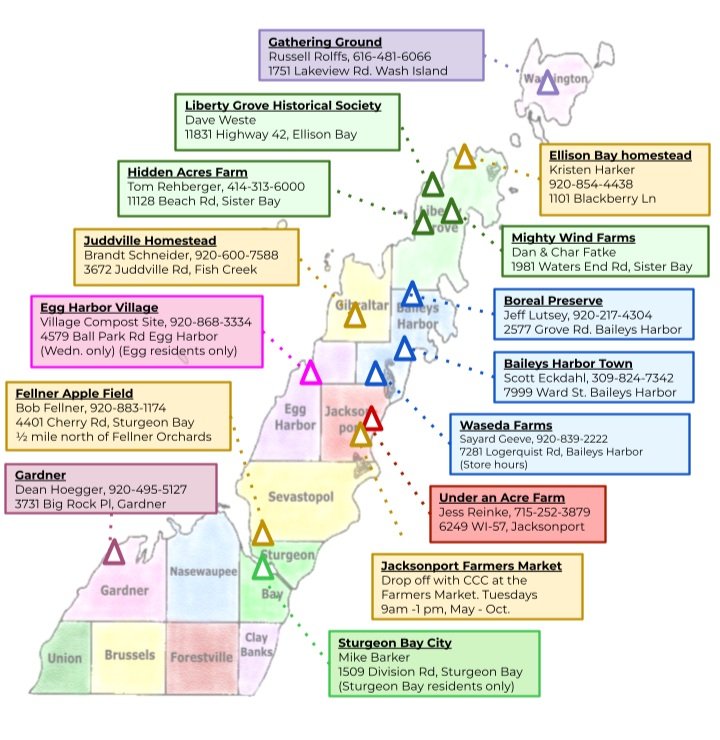
Community Drop-Off Sites: See the map below for the 13 drop-off sites that participate in the Door County Compost Initiative.
 What are invasive species? Aquatic Invasive Species Terrestrial Invasive Species ID & Control Resources What you can do? Looking for more photos of invasive species? A great source for photos is: https://www.minnesotawildflowers.info/. More Resources: https://mipn.org/ Invasives | Wisconsin DNR
Solar Benefits
Ordinance, Permitting, & Process
Gorw Solar Door County Initiative:
growsolar.org/door Grow Solar Door County Initiative Announced - Door County PulseDoor County Solar Buy
Eland Electric is sponsoring a group buy for Door County. To learn more about the group buy, visit doorcountysolar.com.Facts about plastic bags:
In this country, we use an estimated 190,000 disposable bags per second, requiring the use of 12 million barrels of oil each year.
It is estimated that each American uses an average of approximately 500 plastic bags each year. Why should something that we’re going to use for a short time use a material that lasts hundreds of years?
An estimated 32% of all plastic produced--nine million tons!--escapes collection and ends up in the ocean each year.
Over 100,000 sea mammals and 1 million seabirds die each year from ingesting or getting tangled in long-lasting discarded seaborne plastic.
10 Good Reasons to Bring Your Bag:-
Most plastic bags never completely decompose. They are not biodegradable because bacteria will not eat them. They do disintegrate when exposed to sunlight, but they only break into small particles.
-
According to recent EPA statistics, only 4.3% of HDPE plastic (the type used to make plastic grocery bags) is recycled in this country, while the rest of the 100 billion plastic bags we take home from stores every year become litter or go to landfills.
-
Plastic bag litter is so ubiquitous that the Irish have been known to call the plastic bag their “national flag” and South Africans have dubbed it their “national flower.”
-
Plastic bags and other plastic garbage that land in the ocean kill an estimated 1 billion seabirds and marine animals per year, often by choking to death or having plastic wrapped around their intestines.
-
Plastic debris acts like a sponge for toxic chemicals. When tiny particles from disintegrated plastic bags are ingested along with plankton by filter-feeding marine animals, these toxic chemicals (like PCBs and DDE) are passed up the food chain, including up to humans.
-
Plastic bags are typically made from petroleum, a nonrenewable resource. The amount of petroleum used to make only 14 plastic bags would fuel a car for a mile.
-
We make a difference when we refuse a bag for small purchases.
-
We make a difference when we bring our reusable bags instead of taking dozens of disposable bags.
-
We make a difference when we use plastic bags only when no other option is available.
-
We make a difference when we responsibly manage plastic bags by making it a priority to reduce, reuse, recycle, and properly dispose of them, using alternative bags to the maximum extent possible.
To protect Wisconsin’s trees, obtain firewood near where you will use it or use certified firewood that has been properly heat-treated or aged to kill any infesting pests or diseases.
Firewood can transport harmful tree problems to your backyard, street or favorite campsite. Just one firewood log can easily hide insects such as the emerald ash borer or spongy moth, or the tiny spores of a tree-killing fungal disease such as oak wilt. Instead of taking firewood along on your next camping trip or bringing some home with you from far away, get your firewood where you're going to use it. Make sure it is from trees harvested nearby, or buy firewood that has been processed to eliminate pests and diseases. Wisconsin regulates the movement of firewood in the state to help protect our trees and forests. Property owners and managers may also have additional restrictions. Here are some basic rules. Help Protect Wisconsin Trees: Don't Move Firewood - Information Brochure
Rules for all of Wisconsin
The quarantine for the spongy moth prohibits the movement of firewood east to west from infested to non-quarantined WI counties. If moving firewood to or through tribal properties, contact the tribe for its policy on allowable firewood. County, federal, and private campgrounds may have their own firewood restrictions. Call ahead or look online for specific information, including whether firewood is available at the campground.
Rules for state properties
To prevent the spread of emerald ash borer and other invasive insects and diseases moving in firewood, the DNR developed a permanent rule that prohibits visitors from bringing firewood into Wisconsin state parks and other state-managed lands from locations further than 10 miles away from the property (effective June 1, 2014). Treated, pest-free wood from state-certified vendors is exempted from this regulation. To help with trip planning, each state campground has a map showing the 10-mile radius. To help protect the state’s forests from harmful pests and diseases, obtain your firewood at the property, from within this 10-mile radius, or buy state-certified firewood if purchasing the wood more than 10 miles from the property.

What Is Green Tier?
- The systematic approach helps identify and minimize potential environmental risks.
- Regular performance assessments reduce the potential for noncompliance and help facilities improve their overall environmental footprint.
- Annual reports ensure transparency with those potentially affected by a facility’s operations and can be used as a tool to promote environmental achievements to stakeholders.
- Measurable environmental improvement helps differentiate participants from their competition.
- The DNR recognizes Green Tier participants and works to share their stories.
- The Green Tier logo can be used by participants to brand their commitment to superior environmental performance.
- A dedicated DNR staff member is matched to each Green Tier participant. That staff member is there to improve communication and provide a consistent point of contact from the DNR.
- Eligibility for limited liability protections for mistakes that are proactively identified, addressed and self-corrected.
- Tier 2 participants can negotiate innovative regulatory solutions that can result in streamlining permits or allowing for additional flexibilities in operations.
- Developing a good reputation as a sustainable organization.
- Identifying new business opportunities and improving their competitive advantage.
- Increasing employee engagement and satisfaction, which can improve retention rates.
 For more information about who is in Green Tier in the State of Wisconsin, click here.
What is the Village of Ephraim Green Tier Committee Working On?
- Solar Bollards installed for Cherry Street Steps and along the shoreline.
- Additional bike racks installed.
- No phosphorus in fertilizer.
- No use of Coal Tar Sealants
- Reduction in the idling of Village vehicles.
- Clean Marina Certification.
- Tree City Certification.
- Joined the County-Wide Green Tier Consortium.
- Dark Sky Policy Agreement.
- Door County Big Plant Tree Giveaways – 300 trees given away to date.
- County-wide composting initiative.
- Tree mapping of the Village.
- Food Pantry magnets for distribution to Short Term Rentals.
- Newsletter articles (Green Tier updates, composting, and recycling).
- Inaugural Clean Up Ephraim Day was held on June 1, 2024.
- 2025's Clean-Up Day was held on April 19, 2025.
- Completion of the initial stage of the Wetlands Project.

- Trees help absorb the sounds of traffic in urban areas by 40%
- Neighborhoods with trees are 7-9 degrees cooler than those without
- Trees reduce energy costs up to 25% by shading buildings and protecting them from winter winds
- Homes with trees have higher property values
- Green space plays a major role in improving mental and physical health
- Planting and maintaining trees absorb carbon dioxide in the atmosphere, mitigating the effects of climate change
- Publicly demonstrating your commitment to the environment is a great way to build pride among residents, as well as position your community as an attractive place to live. To help you share your award, we send signs, flags, press releases, and other materials after your acceptance
